
From Back Door to Backyard Oasis: Your Outdoor Living Flow Guide
Most homeowners step out their back door and feel a disconnect, like they’ve left the comfort of their home and entered a separate, underutilized space that never quite lives up to its potential. That gap between indoor comfort and outdoor space is one of the most common frustrations in home design, and it’s entirely solvable with the right layout strategy. At Texas Tropic Pools, we’ve spent years helping families bridge exactly that gap, creating backyard environments that feel like a genuine continuation of the home rather than an afterthought tacked onto the property line.
The truth is, great outdoor living isn’t about spending more money or adding more features. It’s about understanding flow. When your outdoor space is designed with intentional transitions, clear zones, and thoughtful sightlines, the result is a yard you actually use every day, not just on holidays. Research from the American Institute of Architects consistently shows that outdoor living spaces rank among the top requested features in residential design, and yet most backyards are laid out without any of the spatial logic that makes indoor rooms feel intuitive and inviting.
This guide walks you through the core layout principles that professional designers use to create outdoor environments with seamless, natural flow from the moment you open your back door.
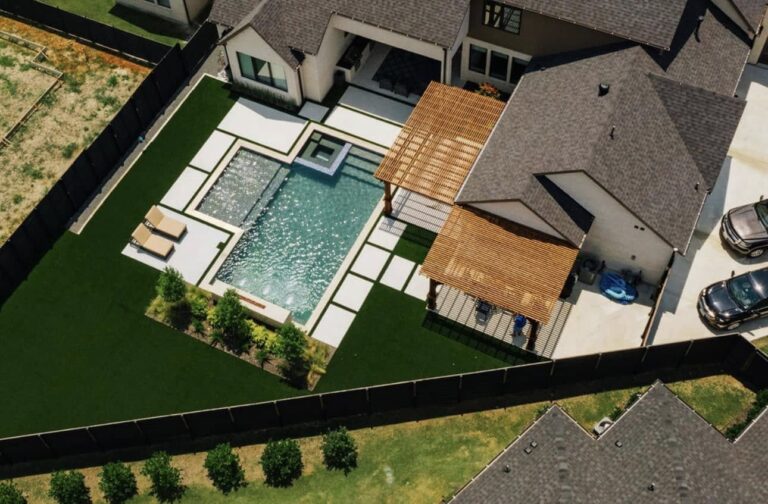
Start With the Threshold: Why Your Back Door Matters More Than You Think
The back door is the hinge point of your entire outdoor design. Whatever greets you in those first few steps sets the tone for how you’ll experience the rest of the space. If you walk out into a patchy lawn or a disorganized patio with furniture pointing in every direction, your brain registers the space as unresolved and you’re less likely to linger.
Create a Defined Entry Moment
Think of your back door the same way an architect thinks about a building entrance. There should be a clear, welcoming threshold that signals you’ve arrived somewhere intentional. This can be a covered pergola structure, a change in surface material from interior flooring to outdoor stone or concrete, or even a simple framing of potted plants and lighting on either side of the door. The goal is a visual handshake between inside and outside.
The surface material you choose for this transition matters enormously. Wide-format pavers that echo the tone of your interior flooring create a visual bridge. Large-format concrete, natural limestone, or travertine all work beautifully in Texas climates because they handle heat without becoming uncomfortable underfoot and they carry a visual weight that feels substantial and considered.
Zone Your Space the Way You Zone a Room
Indoor rooms have distinct purposes, a kitchen for cooking, a living room for gathering, a dining room for meals. Your outdoor space deserves the same level of organization. Without defined zones, a backyard becomes a catch-all where nothing feels purposeful and everything competes visually.
The Primary Gathering Zone
This is your outdoor living room, the largest zone and usually the one closest to the house. It should be large enough for comfortable seating, anchored by a structure like a covered patio or pergola, and oriented to take advantage of shade during peak afternoon hours. In Texas, where summer sun is relentless, this orientation isn’t just comfort, it’s the difference between a space you use and a space you avoid.
The Dining and Cooking Zone
If your layout allows, separate the cooking and dining area from the primary seating zone by at least a few feet of intentional transition. This can be a change in paving pattern, a low planter wall, or simply a shift in the furniture arrangement. The separation creates rhythm in the layout and prevents the space from feeling like one undifferentiated slab of patio.
The Water Feature or Pool Zone
When a pool is part of the design, its placement relative to the house is critical. Ideally, it should be visible from a primary interior window or the gathering zone, not hidden behind a structure or pushed to a corner where it becomes an isolated amenity. A pool that you can see from the kitchen or living room becomes part of your daily life rather than a destination you visit on weekends.
Sightlines, Scale, and the Illusion of Space
One of the most overlooked principles in outdoor layout is sightline management. Where your eye travels when you first step outside determines how large or small the space feels. Long, uninterrupted sightlines to a focal point, whether that’s a water feature, a fireplace, or a beautifully planted garden bed, make a yard feel expansive and designed. Cluttered or obstructed sightlines make even a large yard feel cramped.
Scale is equally important. Oversized furniture on a small patio or tiny planters in a sprawling yard both create visual dissonance that people feel even if they can’t articulate why. Match the scale of your outdoor furnishings and hardscape elements to the actual square footage of the space, and leave breathing room between zones so each area has its own identity.
Lighting Ties It All Together
No outdoor layout conversation is complete without addressing lighting. Lighting is the element that extends usability into the evening hours and transforms how a space feels after dark. Layered lighting, meaning a combination of ambient overhead light, task lighting near cooking and dining areas, and accent lighting along pathways and in landscaping beds, creates depth and dimension that flat, single-source lighting simply cannot achieve.
Low-voltage LED systems have made professional-quality outdoor lighting accessible for most budgets, and the return on that investment in both usability and curb appeal is consistently high. A beautifully designed outdoor space that goes dark at sunset is a missed opportunity.
Bringing It All Together
Designing an outdoor living space that flows seamlessly from your back door is less about any single feature and more about the relationships between features. How does the threshold connect to the gathering zone? How does the gathering zone open toward the pool? How does the lighting at night reinforce the same zones you feel during the day? When all of those relationships are considered together, the result is a backyard that feels like it was always meant to be exactly this way.
At Texas Tropic Pools, this kind of integrated thinking is what we bring to every project. If your backyard feels like it’s missing that sense of connection and flow, we’d love to talk through what’s possible for your specific space and goals. Reach out today to get started with your backyard transformation.